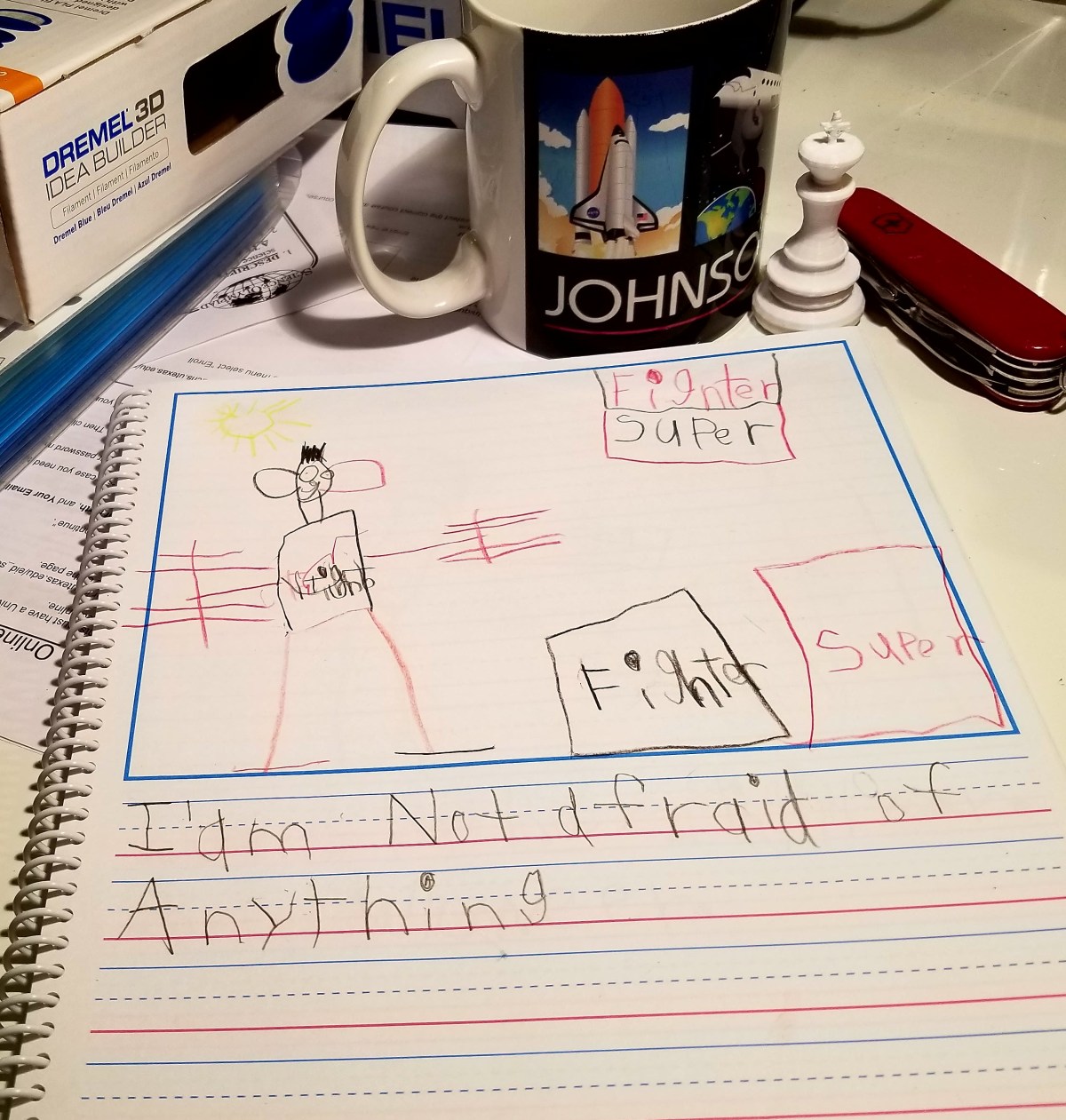
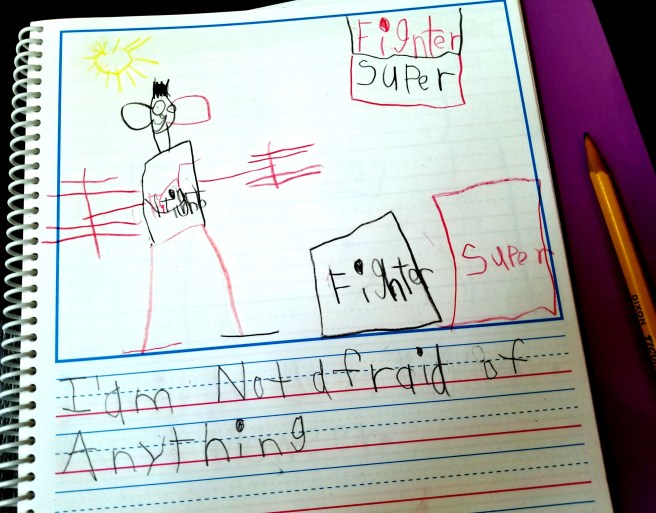
My son drew this when he was about five. He must have been in kindergarten. It made me smile when I chanced upon it rummaging through boxes. For me, it is remarkable that a five-year-old will declare that he is fearless. Fearless! It was a time when he believed in Jedi knights and proudly told other kids that his father was a Jedi. He is eighteen now and I just sent him off to college. I hope he will approach this new milestone with the same fearlessness. In kindergarten he was curious and he was unafraid to explore and ask questions. One incident during that time stands out in my mind. He punched a boy next to him in school. He had never done anything like that in his young life. He told us that the boy was being mean and he would not stop even after he already told him to stop. Well, after punching the boy, he disappeared. Teachers searched for him frantically around the school. Not one of them thought about looking for him in the principal’s office. But there he was, sitting and waiting for the person with the highest authority in the school. My husband and I knowingly looked at each other while the teacher was telling us all this. Out of view from the teacher, we looked at each other and laughed. We knew what he did, he turned himself in at the principal’s office! He stood by what he had done and he was unafraid to face the consequences.
Building up the internal security that will help children cope with stress starts with the baby brain. Baby brains are actively making millions of synaptic connections like a computer in the process of writing and rewriting computer codes. It is writing the codes by which it will function, thrive, and process new information. But the baby brain is not a blank slate, babies are born already with the ability for self-regulation in order to survive. They are able to respond to the external world. The environment plays a huge role as to what codes are written or not written in the growing brain. The codes written in the brain during the early years are very important. Will it run smoothly? Will it be error prone? I certainly hope it will not be prone to crashes. Research on brain development in animals have shown that affectionate caretaking and a rich environment increases synaptic connections. That baby brain will have good programming if it receives supportive and responsive caregiving.
The formation of a secure attachment to the parent or caregiver is one of the initial tasks in child development. It is a process that occurs throughout infancy and the toddler years. Consistent affectionate and responsive caregiving is important for infants in order to develop internal security and normal attachment. This feeling of love and feeling of welcome into the world will translate to individuals who are not afraid to explore and take risks. These individuals will have a well of resilience they can draw from when faced with challenges. These individuals will be able to build healthy relationships because they learned to trust and love others.
” The relationships children have with their caregivers play critical roles in regulating stress hormone production during the early years of life. Those who experience the benefits of secure relationships have a more controlled stress hormone reaction when they are upset or frightened. This means that they are able to explore the world, meet challenges, and be frightened at times without sustaining the adverse neurological impacts of chronically elevated levels of hormones such as cortisol that increase reactivity of selected brain systems to stress and threat. “
(National Scientific Council on the Developing Child. (2005/2014). Excessive Stress Disrupts the Architecture of the Developing Brain: Working Paper 3. Updated Edition. http://www.developingchild.harvard.edu)
Instinctively, majority of parents want nothing more than to love and care for their babies. However, there are factors that may affect caregiving. It may be internal problems in the family such as mental illness or abuse. It may be poverty or lack of education. It could be as far reaching as war, desperate conditions that force families to seek refuge in neighboring countries. Many people may not make the connection but child development and the importance of affectionate caregiving is currently in the front and center of national news. The appalling conditions of detained migrant children and their forced separation from their parents should make us think about the damage being inflicted by these conditions to the developing brains of these young children. More than the short term effects of deprivation of basic physical needs, it is shocking to think about the long term emotional and mental effects these conditions will bring to these children. What type of images will they draw 3-4 years from now? I don’t think it will be that of smiling faces in front of a house with the sun shining in the background. It will not be a proud super hero stick figure of themselves with the sun shining on them. I hate to think about what images they will draw for us.
A few days ago I gave my son a hug and watched him walk towards his dorm. I thought about his drawing years ago and I know he will be alright. At work, I continue to be amazed whenever I see toddlers freely exploring, looking back at mom or dad for censure or approval, and then looking forward and determined to go on his own. Unsure, yet still daring to run away and explore. To some, it may be an ordinary sight, maybe even distressing, but it still gives me goosebumps. Although the young toddler does not have the words yet, his body speaks– “I am not afraid of anything.” It is a beautiful sight.
https://bernardvanleer.org/articles/the-beginning-of-life-short-clips/
 Dear Baby Brain